
Reviewed · PALERMO CITY & MARKET TOURS
Discover the Charm of Palermo: A 3-Hour UNESCO Sites Walking Tour
Three hours, and Palermo clicks into place. This walking tour strings together UNESCO-linked Norman and Arab-Norman sights plus baroque highlights, with stops that also show how Palermo actually lives. I like that it does not just point at monuments, it explains what you are looking at, including mosaics tied to the Palatine Chapel.
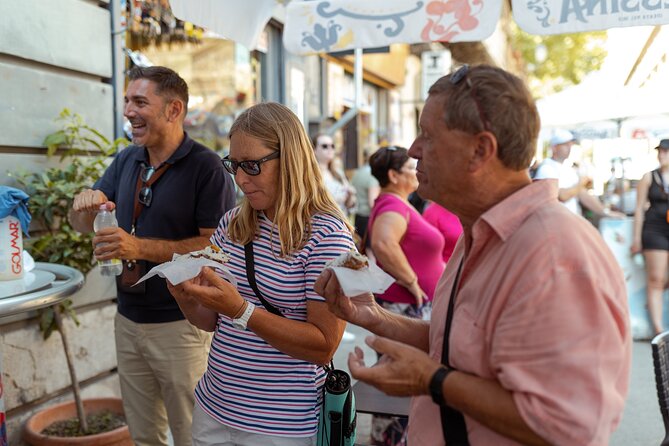
I especially liked two things: the way the route mixes big-ticket landmarks with local street scenes, like the open-air market area near Via Bandiera and the lanes around Piazza Caracciolo. I also love that the tour ends with a typical Sicilian treat, cannolo or granita, so your walk feels like more than just sightseeing.
One consideration: you cover a lot in a short time, and some major works are viewed from the outside, including the Palatine Chapel area. If you want a long, inside-only museum-style visit, plan extra time later.
Key highlights at a glance
- Palermo’s Norman-Arabic look in one walk, from La Martorana to the Cappella Palatina area
- Cathedral time with an actual entry, plus details like an Arabic inscription on a column
- Baroque showpieces nearby, including Piazza Pretoria and Quattro Canti
- Street-food energy built into the route, via markets and central squares
- A small group size (max 20) that makes questions easy to ask
- A sweet finish with cannolo or granita, included with your ticket
Why this 3-hour Palermo route feels like a shortcut
Palermo can feel like information overload when you first arrive. This tour gives you a smart spine for the city, so later, when you wander on your own, you know what you are seeing and why it matters.
The big win is balance. You are not stuck in one era or one neighborhood. Instead, you move through a pattern Palermo does well, old Norman power and Arab influences side by side, then baroque drama showing up around corners.
Also, it is a short enough commitment that it works on day one. That is when you most need orientation, especially in a city with busy streets and lots of foot traffic.
You can also read our reviews of more walking tours in Palermo
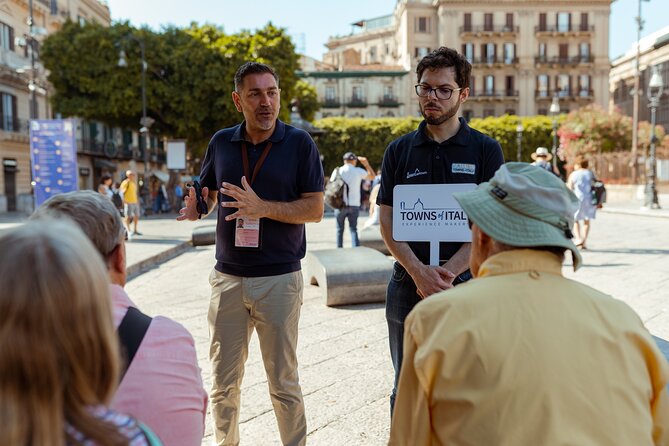
Meeting at Via Volturno, then getting your bearings fast
You start at Via Volturno, 44, and you end back at the same meeting point. No hotel pickup means you get to control timing, and it also keeps the group on track.
From there, your guide leads you through the center at a pace designed for seeing multiple landmarks without turning it into an all-day crawl. Most groups also move as one unit, which helps in tight streets where it is easy to get separated.
If you come with a photo-heavy plan, keep your expectations realistic. The stops are short, so you get good look time, then you move on before the crowd patterns change.
Teatro Massimo to Galleria delle Vittorie: big-city Palermo starts here
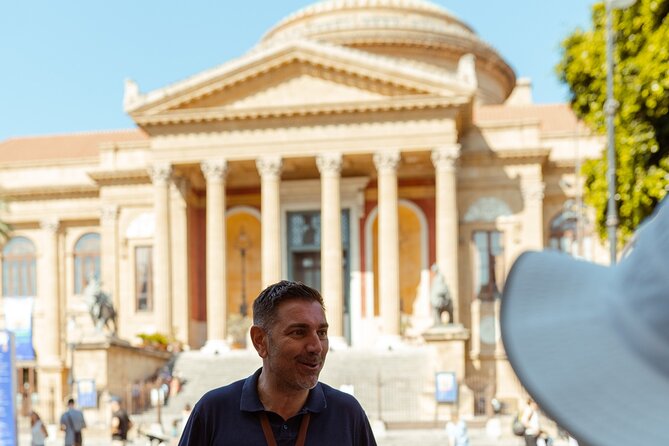
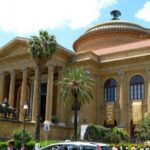
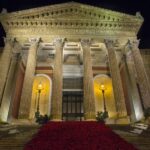
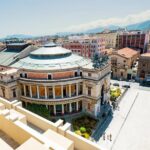
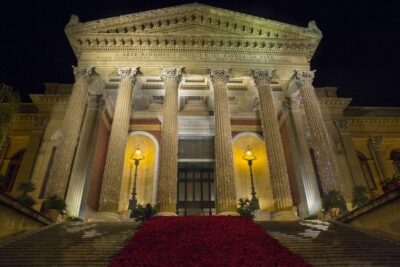
Your first anchor is Teatro Massimo Vittorio Emanuele on Piazza Verdi. This is Palermo’s grand opera house, and it is the biggest in Italy, with a huge scale for its era. The famous part is the acoustics, the kind of detail guides like to point out because it affects the building’s design and even how people talk about performances.
A few minutes later, you pass by the Galleria delle Vittorie. This was built like a commercial mall on Via Maqueda. Over the decades, it deteriorated, and restoration efforts have been attempted, so it is a reminder that Palermo’s modern layers have their own stories, not just the ancient ones.
This stretch is also good for timing your mindset. You are learning architecture, but you are also walking through central city rhythm. That matters because the rest of the tour is not just “look at monuments,” it is “learn how the city forms around those monuments.”
San Domenico and Piazza Caracciolo: the faith, the mafia symbol, and the market pulse
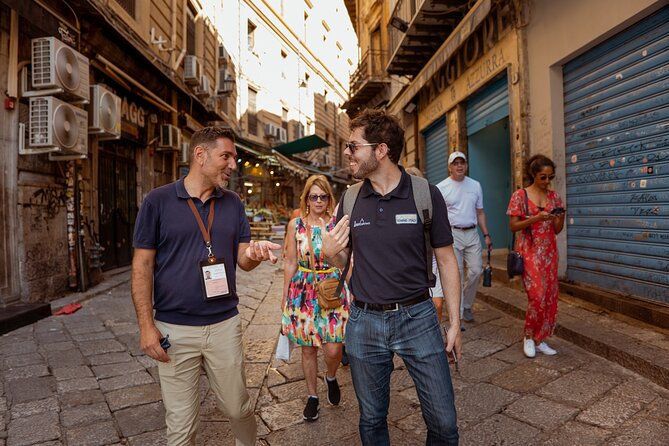
Next up is Chiesa di San Domenico in its square. It is considered one of Palermo’s beloved churches and sits right after the Cathedral in importance. What I like here is the way it is explained as a kind of Palermo civic memory. It is called a Pantheon of the illustrious men of Sicily, so it is not only religious, it is political and cultural.
It is also widely seen as a symbol in the fight against the mafia. That gives the visit weight without turning it into a lecture. You learn the building while also understanding why certain places become modern symbols.
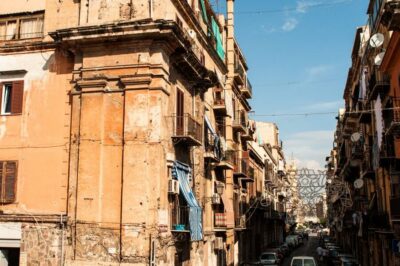
Then you walk through the market atmosphere around Piazza Caracciolo. This is the sort of stop that makes the tour feel current. It is a maze of alleys and adjacent streets, and it is a good place to notice how Palermo blends old-world architecture with day-to-day energy.
You will also hear the origin story of the market name la Bucceria, tied to the French word for butcher shop. Even if you only catch part of the explanation, the point lands fast: this is a city where commerce has always lived close to culture.
Baroque moments: Fontana del Garraffo and the Stock Exchange past
After the market area, you hit the Garraffo Fountain (Fontana del Garraffo) in Piazza Marina, down ancient Cassaro, now Via Vittorio Emanuele. This is a baroque fountain, and baroque here means more than decoration. It means you see drama in stone and water, designed to pull your eyes toward center stage.
From there, you pass the Palermo Stock Exchange history. Trading began in 1845, and the exchange was once the most important in Sicily. It operated in the Palazzo delle Finanze for about a century, and eventually the institutions were unified into a single stock exchange in 1997.
Why does this belong on a UNESCO walking tour? Because the “UNESCO story” in Palermo is not only medieval monuments. Palermo’s significance also shows up in its institutions and the way the city functioned over time.
More Sicily island tours, Etna days, coastal boat trips, and food experiences to compare
The descent of the Judges: a street with a legal backstory
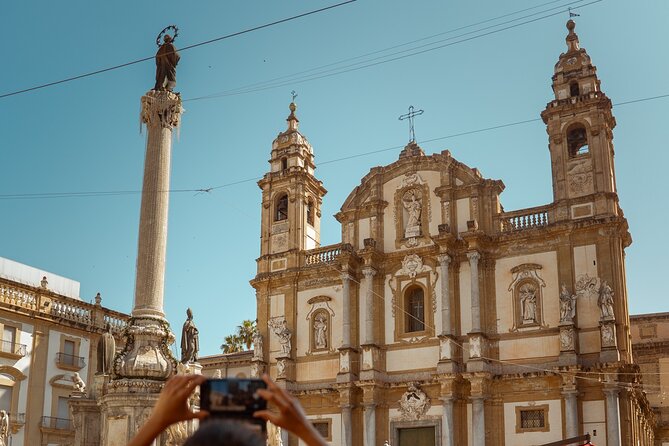
You walk the descent of the Judges, also called calata dei giudici. It runs from Piazza Sant’Anna down to Piazza Bellini. The street gets its name from the Judges of the Praetorian Court, who once lived nearby in the monastery of S. Caterina.
If that sounds too academic, do not worry. The guide’s job is to translate the past into a street-level way to imagine the city. You learn how the court was organized, how judges were elected by the king, and how the term in the street ties to real people, not just labels.
It is a good pause in the middle of the route because it helps you connect architecture to institutions and daily power.
La Martorana (Santa Maria dell’Ammiraglio): Norman-Arabic mix with living tradition
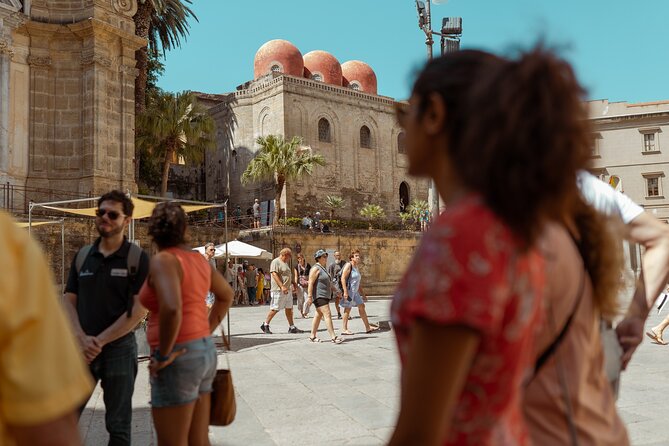
Over the piazza Bellini area sits Santa Maria dell’Ammiraglio, known as La Martorana. This church is tied to the Greek-Byzantine presence in Palermo, and that is the point you should keep in mind as you approach.
Built between 1143 and 1185, it was created by the Greek admiral George of Antioch, who dedicated it in thanks for protection. It was handed to Greek-Byzantine clergy, and ceremonies are tied to ancient Greek or Albanian language through the Italo-Albanian Catholic Church structure.
That living-language detail is not window dressing. It explains why Palermo’s architecture feels layered. It is not only “different styles,” it is different communities and practices leaving marks in stone and ritual.
Piazza Pretoria and Quattro Canti: when baroque design becomes a map
Now you move into two of Palermo’s most recognizable baroque spaces.
Piazza Pretoria sits near the Kalsa district and just by the corner of Cassaro with Via Maqueda, near the Quattro Canti intersection. The fountain in Piazza Pretoria was created for Don Luigi de Toledo’s garden in Florence. In Palermo, that plot was once a garden belonging to the nuns of San Domenico al Maglio, and after pressure it was obtained in 1551.
The fountain was commissioned to Florentine sculptor Francesco Camilliani, student of Baccio Bandinelli. The result: you get a baroque showpiece with a backstory that crosses cities, not just empires.
Then comes Quattro Canti, also known as Piazza Vigliena. This is Palermo’s famous four-corner square, built between 1608 and 1620, with decorative elements completed in 1663. It’s one of the best places to reset your mental map, because the design helps you understand how the old quarters intersect.
Even if you take only a few minutes to look up, you will feel how the city “turns” around this spot.
Cattedrale di Palermo: Norman architecture plus Arabic traces you can spot
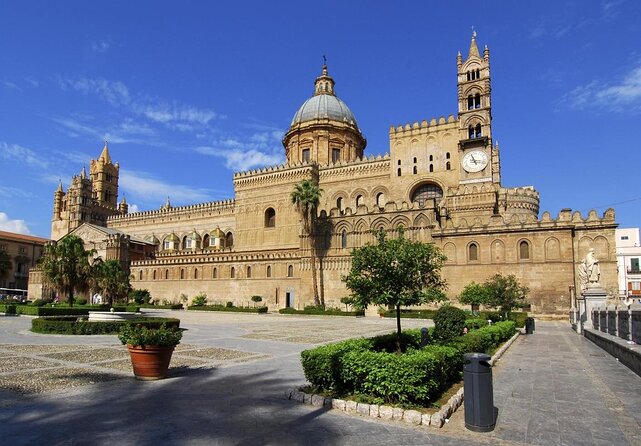
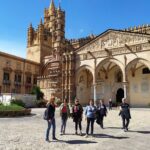
The highlight stop is Cattedrale di Palermo. Admission is included on this tour, and that matters, because the Cathedral is where style layers become visible in real life, not just on postcards.
The Normans built it in 1184 on a site that previously held a Muslim mosque, itself built over an older Christian basilica. So when you look at the Cathedral, you are not just looking at one “period,” you are looking at a timeline made of buildings.
Your guide also points out how Palermo’s competitiveness with nearby sites influenced the Cathedral’s presentation. You see Gothic, medieval, Arabic, and neoclassical elements mixed over the centuries. One detail you should listen for, because it is memorable, is that an actual passage from the Koran is engraved on a column.
This is the best place on the route to slow down, even if your tour timing keeps things moving. If you get one “listen carefully” moment, make it here.
Villa Bonanno and the Palazzo dei Normanni: what you can learn outside
After the Cathedral, the tour shifts to the Norman royal area.
Villa Bonanno is a garden behind the Palace of the Normans, near Victory Square. Built in 1905, it is a garden that stays open, lined with palm trees, plus statues and busts of notable Palermo figures. It also has the Roman patrician houses remains with mosaics, including mosaics of the seasons and Orpheus. Those mosaics are kept at the National Archaeological Museum, so you get the site connection here without expecting the museum display on the spot.
You are then led toward Palazzo dei Normanni, also called the Palace of the Normans. This is described as chronicling Palermo’s history from early Punic settlements onward. One reason the palace matters for this walking tour is the Cappella Palatina, the Palatine Chapel, part of an Arab-Norman art story.
Your tour focuses on learning about the Palatine Chapel mosaics from the outside rather than providing the interior ticket. That is a good approach for a 3-hour program because it preserves time for other UNESCO-linked streets and squares.
You may also hear about the Torre Pisana, which houses the Palermo Astronomical Observatory and the Specola Museum, plus temporary exhibitions in rooms connected to the Duke of Montalto halls. Even if you do not go inside on this specific walk, the guide’s context helps you appreciate why the palace complex is so significant.
What you’re really paying for at $31.88
At $31.88 per person for about 3 hours, you are paying for three things: a licensed English guide, entrance to the Cathedral, and the included ending treat.
You are also paying for time saved. Palermo’s historic center is dense. With a guide, you do not waste the first day guessing which streets connect to which eras, or which buildings are worth your climb to look closely.
The group stays small, max 20 people. That helps you hear explanations and ask follow-ups, and it also keeps you from turning the tour into a crowded shuffle.
The cannolo or granita included at the end is not a gimmick. It is timed right after one of the most impressive visual stops (the Cathedral) and another cluster of baroque squares, so the sweetness feels earned.
Pace, practical tips, and the one thing to plan around
This is a lot of walking in a compact window. Expect short pauses, not long lingering. If you are a slow walker, you might feel the schedule. If you are fast and curious, you will like it.
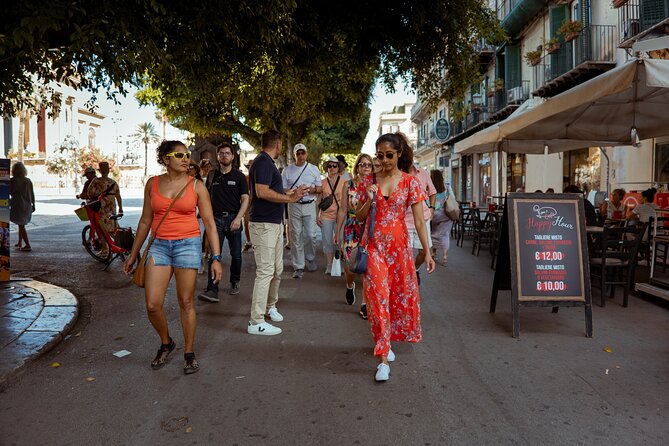
Palermo’s streets can be tight and busy. Plan for a bit of chaos, especially around market areas and central intersections, and keep your phone and bag secure when you stop for photos.
Restrooms can be tricky in old-city walking routes. I suggest you use one before the tour starts if you can, and carry a little patience for the rest of the day.
Finally, bring water. A three-hour walk can feel longer in warm weather, and you will be outside for most of it.
Who this tour suits best
You’ll love this tour if you want an efficient orientation to Palermo’s top UNESCO-linked areas, plus practical “what am I looking at” explanations. It also works well as a first morning or first afternoon plan, because it gives you a city map made of monuments and streets.
You might choose something else if you want deep time in one site, like spending a long session inside the most famous palace chapel mosaics. This walk is built to cover territory, so it favors breadth over extended indoor hours.
Should you book this Palermo UNESCO sites walking tour?
Yes, if you want the best kind of first-day planning. For the price, you get guided context, Cathedral entry, and a real Palermo snack at the end, all in a route that strings Norman, Arab, and baroque Palermo together in a way that makes the rest of your trip easier.
Book it soon if your dates are fixed. It tends to be reserved about a month in advance on average, which usually means popular time slots go first.
If you are flexible and want to get your bearings fast, this is a strong starting point for Palermo.
More Walking Tours in Palermo

More Tours in Palermo
More Tour Reviews in Palermo
Not for you? Here's more nearby things to do in Palermo we have reviewed



Palermo City & Market Tours, compared.
 ★ 4.8Palermo: NO Mafia Walking TourFrom $402,431 reviews
 ★ 3.9Palermo: Hop-on Hop-off Bus Tour 24-hour TicketFrom $172,410 reviews
 ★ 5.0Palermo Original Street Food Walking Tour by StreatyFrom $832,105 reviews
 ★ 4.2Segesta, Erice and Salt Pans Full-Day Excursion from PalermoFrom $821,791 reviews
 ★ 4.5Palermo: Teatro Massimo Opera House Guided TourFrom $141,573 reviews
 ★ 4.2From Palermo: Monreale and Cefalù Half-Day TripFrom $711,354 reviews
 ★ 4.9Palermo: Street Food and History Walking TourFrom $541,294 reviews
 ★ 4.2Palermo: Agrigento and the Valley of the Temples Day TourFrom $771,240 reviews
Browse the lists this tour appears in