
Reviewed · CATANIA CITY & FISH MARKET TOURS
Underground Catania
Catania has a secret level under your feet. This Underground Catania tour takes you into hard-to-find spaces beneath the city, from Roman thermal rooms to lava-carved crypts. It is a great way to understand how Etna, earthquakes, and rebuilding shaped Catania over centuries.
I love the small-group size (max 8) and the fact that you get time with an archaeology guide who connects the sites to the big story of Sicily. You will also appreciate that several stops include entry tickets, so you are not constantly calculating add-ons. The one thing to consider is that a few guests felt the pace could be a bit slower, so if you hate lingering, you may want to ask for a tighter tempo when you meet your guide.
Key things I’d plan for
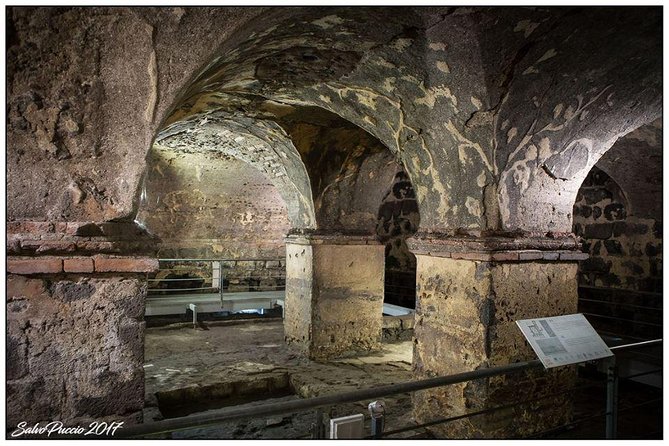
- Roman thermal rooms under Piazza Duomo at Terme Achilliane, with an accessible portion right below the cathedral area
- Basilica di Sant’Agata layers that tie Norman beginnings to later Baroque reconstruction
- Amenano underground water story at A Putia dell’Ostello, where a river branch still runs
- Lava-flow cave converted over time at San Gaetano alle Grotte, from cistern to catacombs
- Guides who actually teach (Oreste, Maria, Matilde Russo are specifically mentioned in past tours)
- A practical route around central Catania, ending near Piazza Stesicoro after about 2 to 3 hours
Why Catania’s best scenes are underground
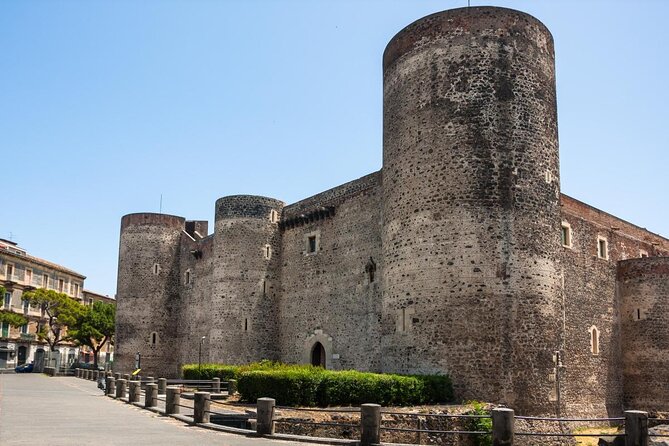
Catania is built on lava, and it shows. Even if you have never studied volcanology, the city’s underground spaces make it easy to grasp the pattern: lava flows created real cavities and rock corridors, then people reused them for practical needs like water storage, burial, and places of worship.
Add in the human layer, the repeated cycles of destruction and rebuilding after major events, and the underground becomes more than a spooky novelty. It becomes a timeline. In this tour, you connect that timeline from Roman-era life, to later faith and civic identity around Sant’Agata, and to the way the landscape kept getting reshaped.
And yes, there is a very practical upside too. Underground sites often feel cooler than the streets when Sicily is cooking, and a few guests specifically liked this as a break from heat.
You can also read our reviews of more tours and experiences in Sicily.



The 2 to 3 hour route, start at Duomo and end near Stesicoro
The tour is designed as a short city crawl that stays mostly in the center. You meet at Piazza del Duomo, 7 and you finish at Piazza Stesicoro (near the start area you will likely find signposted meeting context). Expect about 2 to 3 hours total.
The pace matters. Multiple guides have been praised for stories and flexibility, including adjusting timing when needed. Still, a couple comments point out slower walking at times. My advice is simple: if you have a tight schedule after your tour, keep a little buffer.
You also get real group intimacy here. The experience runs for up to 8 travelers, and the tour is described as private for your group. In plain terms, you should think “small-group guided access,” not a big coach tour with a crowd you never talk to.
Stop 1: Terme Achilliane under the Duomo area
Your first major underground stop is Terme Achilliane, a vast thermal complex dating to the 3rd to 4th century AD. This site originally extended into the area around Piazza Duomo.
Here’s what makes this stop stand out: you are not touring some separate attraction far away from the city. You are seeing a piece of the ancient baths that is preserved and accessible just below the cathedral area. That physical connection to what is above you helps you picture how Romans used the city’s heat and water in daily life.
One practical note from the tour details: the admission ticket is included here. So you can focus on the explanations instead of managing cash or extra lines.
If you are the type who likes to understand how a city worked, this is the anchor stop. Baths were social hubs, engineering showcases, and part of public health. Even when the accessible portion is limited, the guide’s job is to help you see the bigger original layout.
Stop 2: Basilica Cattedrale di Sant’Agata, Norman roots to Baroque rebuilds
Next up is the heart of Catania, the Basilica Cattedrale di Sant’Agata. This is where the city’s sacred and civic identity overlap.
The tour frames the basilica through several eras. You get the story from an original Norman-era church concept, the later Baroque cathedral you see today, and the repeated cycle of destruction and reconstruction over centuries. The names tied to the basilica help keep the narrative grounded: the tradition centers on Sant’Agata and the civic symbol linked with Liotru.
This stop is also practical. The tour includes the cathedral visit with admission ticket free. So you are not paying again just to stand under a famous façade and learn how it got there.
What I like about this stop for travelers is that it prevents the trip from becoming only geology trivia. It connects underground rock and water to human meaning: why people built and rebuilt here, and why Agatha is still a living part of Catania’s culture.
Stop 3: A Putia dell’Ostello and the Amenano river branch
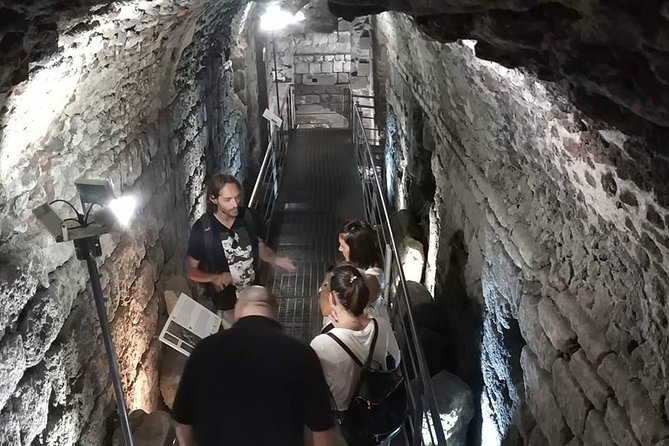
Then you move from “ancient buildings” to “the city’s underground plumbing story.” A Putia dell’Ostello centers on the Amenano, an underground river that historically wound under Catania’s historic center.
Originally, the Amenano fed the Lake of Nicito at the surface. Over time, eruptions, earthquakes, and wars changed not just the urban plan but also how the natural system appeared. This is one of those tours where the landscape is not scenery, it is the plot.
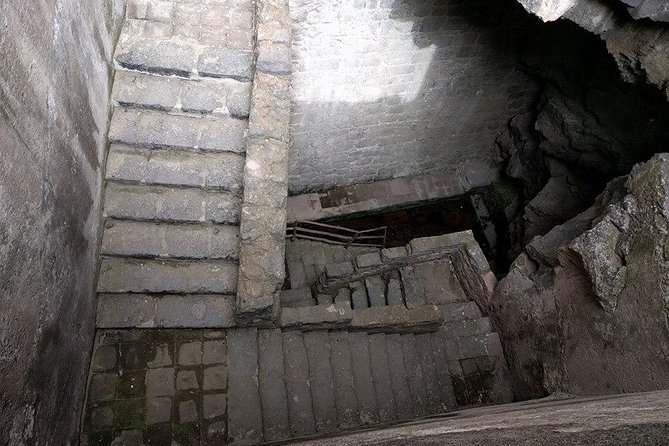
What you visit here is a sliding cave linked to the underground river system, and the tour highlights that a branch of the river still flows. That small sentence matters. Even if you do not fully map the hydrology, you feel the point: this is not a dead set. It is a functioning part of the water story that survived major disruptions.
The tour also includes admission ticket included for this stop. So you again get to spend your mental energy on the guide’s explanations rather than on logistics.
A tip for this part: wear comfortable shoes with good grip. Underground spaces can involve uneven ground and short stair segments, and you want to keep your attention on where you are stepping while still taking in the rock formations.


Stop 4: Chiesa di San Gaetano alle Grotte, a lava cave turned crypt
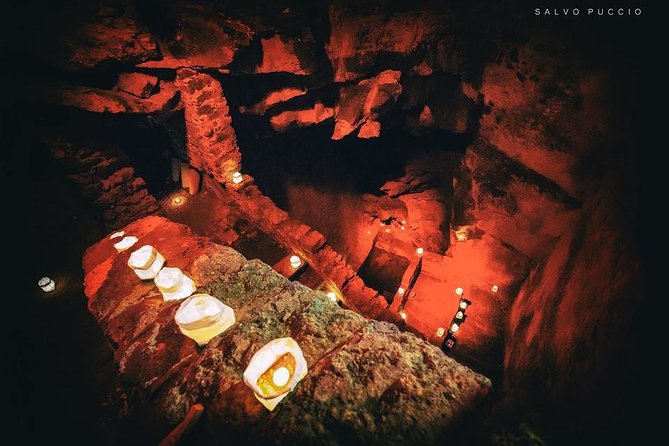
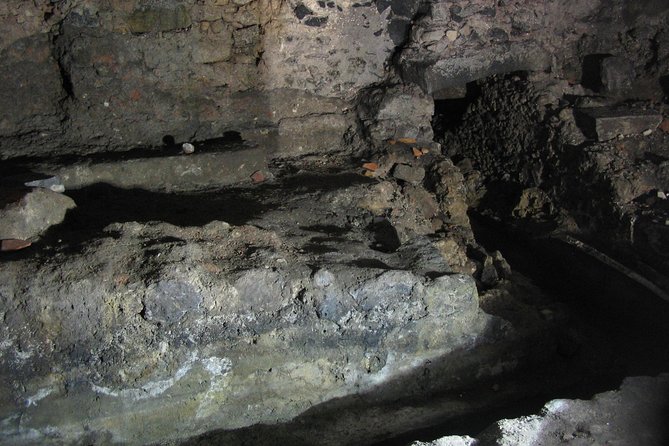
Your last stop brings the biggest “wow” factor for many people: Chiesa di San Gaetano alle Grotte. This site is built in an ancient lava-flow cave.
The tour’s timeline is what makes it special. According to the tour description, the cave was reused in Greek times as a cistern, then later by the Romans as a catacomb tomb space. Then tradition adds the religious layer: it is linked to the first deposition of Saint Agatha, with a small church built as early as 262.
Today, the crypt preserves remains of ancient frescoes and decorations carved directly into living rock. That detail matters because it explains what you are looking at. You are not just visiting a cave church, you are seeing evidence of how people marked and used raw volcanic material for art, devotion, and burial.
This stop includes admission ticket as part of the tour too, so it stays good value on paper. If you like places where faith, engineering, and geology meet, you will probably rank this as your favorite.
The guides: Oreste, Maria, and Matilde Russo bring the underworld to life
One consistent theme in the tour results is that the guide can make or break an underground experience. Here, guides are repeatedly praised for teaching skills and passion.
Names that show up in past tours include Oreste, Maria, and Matilde Russo (also spelled Matilde in other comments). People highlight the way these guides explain the city in context, not as disconnected facts. You get stories tied to earthquakes, volcanic activity, and how those events reshape what you see above ground.
Guides also seem willing to adapt. One review notes the guide adjusted timing for the group’s needs. Another praises flexibility even when weather was rainy. That matters because underground paths often feel more confined and slower when conditions are wet, so a calm, organized guide helps the whole experience feel smooth.
The one drawback worth respecting is pacing. A couple comments mention the guide walking a bit slow. That does not mean the tour is bad, it means you should go with the expectation that this is a story-first experience, not a sprint.
Price and value: $96.79 for a taught access pass
At $96.79 per person for roughly 2 to 3 hours, this is not a cheap casual walking tour. So does it deliver value? For the right traveler, it usually does.
Here is why it can feel worth it:
- You get guided archaeological storytelling tied directly to the sites you are standing in
- The route includes multiple underground and historic spaces, not just one “main” attraction
- Several stops include admission tickets, and the cathedral stop is listed as ticket free
- The group cap at 8 travelers tends to make questions and back-and-forth more realistic
- It is described as private for your group, which is a big part of the pricing logic
The main value watch-out is your expectation of how private it will feel. The tour is marketed in a way that suggests privacy, and it also has a hard max 8 limit. If you want one guide devoted only to your party with no mixing, it is worth clarifying what they mean by private and how they manage small-group logistics.
Also, the tour sells steadily. It is commonly booked about 48 days in advance on average. That is a clue to act early if your dates are fixed.
Who should book Underground Catania, and who might skip it
Book this if you fall into any of these groups:
- You enjoy history that is tied to physical places, especially Roman life and later religious heritage around Sant’Agata
- You want a clear explanation of how Etna activity, earthquakes, and rebuilding shaped the city
- You like unique access, places that are hard to find and harder to access on your own
- You want a cool break from street heat, since several stops are underground
You might skip it if:
- You want a hands-on volcano adventure. This tour is about Catania’s underground layers, not a summit viewpoint
- You dislike tours with a story-and-stop approach, because a couple comments suggest it can run slower at times
Should you book this Underground Catania tour?
If you care about Catania beyond the street highlights, this is a strong choice. The combination of Roman thermal remains, underground water connections, and a lava cave crypt gives you a full, legible view of how the city works at ground level and beneath it.
My biggest reasons to book:
- You get several distinct underground experiences in one outing
- The guide names that show up repeatedly are a sign the operator takes teaching seriously
- Ticket costs are partly covered, which helps justify the price
My biggest reason to hesitate:
- If you are chasing speed and you are very time-crunched, the walking pace might feel slow, so plan your day with buffer time.
FAQ
How long is the Underground Catania tour?
It runs about 2 to 3 hours.
What is the group size?
The tour has a maximum of 8 travelers.
Is the tour offered in English, and do I get a mobile ticket?
Yes, it is offered in English, and it uses a mobile ticket.
Where do I meet, and where does the tour end?
You start at Piazza del Duomo, 7, 95131 Catania CT, Italy, and it ends at Piazza Stesicoro, 95100 Catania CT, Italy.
Are entrance tickets included for the stops?
Terme Achilliane includes an admission ticket. A Putia dell’Ostello includes an admission ticket. Chiesa di San Gaetano alle Grotte includes an admission ticket. The Basilica Cattedrale di Sant’Agata has free admission ticket.
Can I cancel for a full refund?
Yes. You can cancel up to 24 hours in advance for a full refund.
More Tour Reviews in Sicily
Not for you? Here's more nearby things to do in Sicily we have reviewed









Catania City & Fish Market Tours, compared.
 ★ 4.8Catania: Mount Etna Morning or Sunset Day Trip with TastingFrom $704,028 reviews
 ★ 4.8Catania: Sunset Jeep Tour of Mount Etna and Lava Flow CavesFrom $712,113 reviews
 ★ 4.9Catania: Mount Etna Trekking Trip off the Tourist PathFrom $781,351 reviews
 ★ 4.8Catania: Etna Sunset Tour with Pickup and Drop-offFrom $711,348 reviews
 ★ 5.0Mt. Etna and Taormina village full day tour from CataniaFrom $1181,155 reviews
 ★ 4.7From Catania: Mount Etna Sunset Tour with Tasting and CaveFrom $451,119 reviews
 ★ 4.8Catania: Etna Morning Excursion with Tasting and PickupFrom $67820 reviews
 ★ 4.9Catania: Amazing Etna Morning Tour with Pickup and Drop-OffFrom $81799 reviews
Browse the lists this tour appears in