
Ortigia by tuk-tuk saves your legs and time. In about four hours you glide between Syracuse’s top squares, seaside viewpoints, and the Neapolis archaeology park, with short stops to hop out and look around in Ortigia and beyond.
I especially like two things here. First, the ride gets you into parts of Syracuse that are slow or annoying on foot, including narrow alleyways, so you spend less time stuck and more time seeing. Second, the route mixes big landmarks with local life, including Mercato di Ortigia, where you can walk past fish stalls and then visit a family-run preserves shop with long experience in traditional products.
One consideration: at several stops, the driver usually doesn’t walk with you into buildings, so you should be ready for self-guided time on your own (audio guide on your phone can help if you want deeper explanations). Also, it’s a short-stop format, so if you want to linger for an hour in every church, this may feel like a bit of a sprint.
Key things to know before you go
- Private ride for up to 4: you control the pace within the stop times, and you stay together as a group.
- Short hops between highlights: Duomo square, Fonte Aretusa, temples, and viewpoints are built into a single loop.
- Mercato time in Ortigia: fish stalls, street energy, and a stop at a local preserves maker.
- Neapolis is the one ticketed piece: the archaeological park entry is not included, so budget extra.
- Some stops are self-guided: the driver typically handles the ride, while you handle the walking inside.
Why this Ape-TUK loop works for a first visit to Ortigia
If you only have one half day in Syracuse, this is a smart way to get oriented. Ortigia is packed with churches, fountains, and small squares. On foot, that can turn into stop-and-go fatigue quickly. On a tuk-tuk style ride, you get the overview plus the key moments.
The timing also makes sense. You’re not stuck on a single long transfer between far-apart sights. Instead, you get repeated little breaks, so you can enjoy the scenery, take photos, and still fit in major stops like the Temple of Apollo and the Neapolis archaeological park.
Most of the stops are quick looks from the square or the entrance area, with the Neapolis park reserved for a full hour. That structure is ideal when your goal is to see a lot without turning your day into a leg workout.
You can also read our reviews of more tours and experiences in Sicily.

Pickup, meeting point, and how the ride changes your day
You meet at Piazza Emanuele Pancali, 17, 96100 Siracusa. The tour ends back at the meeting point, so you don’t have to worry about figuring out a separate drop-off.
Pickup is offered. If you’re staying inside Syracuse city and Ortigia, you can indicate the exact spot where you want the tuk-tuk (ape calessino) to collect you. That matters because Ortigia streets can be tight and parking can be a headache.
This is private transportation, and it’s designed for an easy group experience. It also helps if your route planning is overwhelmed. Instead of you trying to stitch together buses or taxis between major landmarks, the tuk-tuk handles the connecting tissue.
Practical tip: if you care about specific timing, tell the driver at the start where you want extra attention, and where you’d rather just look and move on. One reason people rave about certain guides is their willingness to adjust within the route, including giving you extra time at the Duomo area when the group wants it.
Stop-by-stop: from Syracuse Cathedral to Apollo’s Temple
Your route starts at the heart of historic Syracuse.
Stop 1: Syracuse Cathedral (Piazza Duomo)
You’ll be in Piazza Duomo, a classic Mediterranean-feeling square. You can visit the Cathedral itself, where admission is listed as €2 per person. The stop is about 15 minutes, which is enough time for a quick inside look if lines are reasonable, plus time to enjoy the square setting.
A heads-up: if you want photos without rushing, factor in a bit of walking and possibly time for entry. With the stop length being short, this is one place where being ready to move matters.
Stop 2: Fonte Aretusa
Next is a brief look at Fonte Aretusa, tied to local mythology. You get around 10 minutes here. That’s perfect for capturing the fountain and taking in the scene without feeling like you’ve been pulled away for too long.
Stop 3: Maniace Castle (Castello Maniace)
You reach Castello Maniace. The terrace entrance is free by choice, and you can visit the castle for a fee. Your stop is about 15 minutes.
This is a good stop if you like viewpoints and coastal scenery. Even if you skip the paid interior, the terrace option can still give you a satisfying picture moment.
Stop 4: Piazza Archimede (Diana Fountain)
A quick stop at the Diana fountain in Piazza Archimede, about 10 minutes. This is more of a visual breather than a deep-dive stop, and it helps keep the route flowing.
Stop 5: Temple of Apollo (Tempio di Apollo)
Then comes the Temple of Apollo, a 6th-century BC site. The time here is around 10 minutes. For most people, that’s enough for a focused look at the exterior and the key viewpoint angles.
If you’re the type who likes reading every sign, you might want to take a moment with your phone to interpret what you’re looking at. Since stop times are short, any prep helps.
Churches and the Giudecca area, then onto the Ortigia market
After the main monuments, the tour leans into smaller streets and places that give Ortigia its character.
Stop 6: Chiesa di San Giovanni Battista
You’ll visit the Giudecca Jewish area, with Chiesa di San Giovanni Battista on the list. The stop is about 10 minutes. This kind of short visit can work well if you’re using the ride to reach places you might otherwise miss.
Stop 7: Chiesa di San Filippo Apostolo
Another Giudecca district church, also about 10 minutes. Together, Stops 6 and 7 create a nice cultural contrast to the more “big monument” moments earlier in the route.
If you care about context, pick one theme for the churches, for example Jewish community history in Ortigia, or sacred art and architecture style. Doing that helps you get more out of short stops.
Stop 8: Mercato di Ortigia, plus a local preserves maker
This is the biggest “local life” block. You’ll spend about 40 minutes at the Mercato di Ortigia, including time inside to see the characteristic fish stalls and other market activity. Then you’ll stop at F.lli Burgio, a local family business producing preserves for decades using exclusively local products and traditional methods.
This market stop is often where the value feels most real. Even if you’ve seen food markets elsewhere, Ortigia’s combination of seafood stalls and old-school local production makes it different. It’s also a great time to pick up edible souvenirs, like preserves that keep well.
Bonus tip: if your guide has good local instincts, ask where locals eat nearby after the tour. Some guides in the past have been able to recommend lunch and shopping based on what your group likes.
Small port: Sbarcedero Santa Lucia
There’s also a short stop at the small port of Sbarcedero Santa Lucia. Even without a long walk, the port moment helps connect the sightseeing to the sea, and it breaks up the day nicely.
Viewpoints that make Syracuse feel bigger than it is
Next you get some of the panoramic anchors that make Syracuse easy to understand from a tourist point of view.
Stop 9: Monument to Syracuse Fallen in Africa
This is about 10 minutes at a panoramic point. Short as it is, a viewpoint stop can change how a city “reads” to you. From up high, you can usually connect the dots between neighborhoods, the coastline, and where the big monuments sit.
Stop 10: Santuario Madonna delle Lacrime
About 15 minutes at the Sanctuary of Madonna delle Lacrime. This sanctuary was inaugurated by Pope John Paul II in honor of a miracle that took place in 1953.
Even if you’re not religious, it’s still a major stop because it’s the kind of site that affects how locals view the area. You also get a pause from outdoor walking.
Stop 11: Basilica Santa Lucia al Sepolcro
Another 15-minute church stop, in the Borgata district. This basilica is the spot where a Caravaggio painting is exhibited. That alone is enough reason for most people to want at least a quick look, especially if Caravaggio is on your list.
Here’s a practical thought: because the tour is built around quick visits, you might want to take your time with just one or two features inside, rather than trying to see everything.
Neapolis Archaeological Park: your one longer ticketed stop
The tour’s final major section is Parco Archeologico della Neapolis, for about one hour. It includes three key stops within the park:
- the Greek Theater
- the Ear of Dionysus
- the Roman Amphitheater
Here’s the important part for planning: admission to the archaeological park is not included. The ticket cost is listed as from 10 to 20 Eur per person.
So yes, you pay extra here, but you also get the tour’s most “big-ticket” classical archaeology segment. One hour is a workable length for a first look at these three highlights without turning it into an all-day archaeology mission.
If you’re deciding between spending extra money or squeezing Neapolis in on your own, this organized stop is the value. You get the transport into the park loop plus the structure of what to see.
Practical tip: if you want more explanation inside the park, consider having an audio guide ready on your phone. This also solves the other practical issue that the driver often does not guide you through the interiors.
Price and value: $415.42 for up to 4 people
The price is $415.42 per group, up to 4 people, for about 4 hours.
On paper, it’s not “cheap.” But tuk-tuk style tours in small cities can be cost-effective if you split it among a group and if it replaces multiple taxis or time-consuming transit. Since this is private transportation, you’re paying for convenience, tight routing, and a driver who can handle narrow streets and quick turns between stops.
Where it becomes good value is when you realize you’re covering:
- multiple church stops
- major Ortigia landmarks and viewpoints
- Mercato di Ortigia time plus a local preserves maker
- and an hour in Neapolis
You’re not paying for a long, meandering route where you spend most of the day just moving. This one is built as an efficient loop.
My suggestion for value math: if you’re traveling as a duo, it may feel expensive. If you have three or four people, the per-person cost drops fast, and it starts to look like a smart use of limited time.
Also note the cost you need to budget separately: Neapolis entry is not included. The cathedral can have a €2 per person admission note. Plan for small additional fees on top of the tour price.
What it’s like with the guide: navigation, pacing, and local instincts
One of the biggest strengths of this tour style is how much the guide affects your comfort. In past experiences, guides like Marco, Francesco, Angelo, and Andrea were praised for being friendly, patient, and ready to adapt.
A few patterns show up again and again:
- The guides maneuver through narrow alleyways and side streets that you might avoid on your own
- Some guides give extra time when your group wants it, especially around Duomo square
- Guides often know good places for lunch and shopping after the main route
- Some guides have personal connections that can lead to food samples or local recommendations at the right moments
- If someone in your group has mobility challenges, a patient driver can help you manage the walking
One practical caution is also real: in at least one case, the driver used a translation app for general city talk, but did not join for walking inside the sites. That means the tour works best as a transportation-and-orientation experience, not as a full museum-style guided walkthrough.
If you want deeper story time inside churches and temples, bring a plan. Download a few audio tracks in advance, or think about adding a dedicated guide for the one site you care about most.
Who should book this tour, and who might skip it
I’d book this if you want:
- an efficient first pass through Ortigia and Syracuse
- an easy way to reach far-flung sights without wrestling with transit
- a mix of major monuments plus a real market stop
- a private setup where your group can set priorities
It might be less ideal if you:
- hate walking at all, since you’ll step out for multiple short visits
- expect the driver to act like a guide inside every building
- want long stays, for example 45 minutes inside each church, rather than quick looks
If you’re traveling with kids, this can work well because the ride is fun and the stops are short. If you’re an adult who likes structure, it’s also easy to follow.
Should you book this Ape-TUK tour of Ortigia and Syracuse?
If your schedule is tight and you want the main Syracuse and Ortigia highlights without wearing yourself out, I think this is a strong choice. The best part for most people is the balance: you get major sights like the Temple of Apollo and the Neapolis park, plus a market moment that feels local and not staged.
Book it early if you can, since the tour is often planned well in advance. Once you’re there, go with a clear mindset: this is a ride with smart short stops. If you want deeper explanations, use your phone for audio and focus your attention on just one or two sites inside the buildings.
If that approach matches how you like to travel, you’ll probably have a great half-day in Sicily’s most photogenic streets.
FAQ
How long is the Ape-TUK Tour of Ortigia, Syracuse, and Neapolis?
The tour is about 4 hours.
What does the tour cost?
It costs $415.42 per group, up to 4 people.
Is this a private tour?
Yes. It is private, and only your group participates.
Where do we meet the tuk-tuk?
The meeting point is Piazza Emanuele Pancali, 17, 96100 Siracusa SR, Italy. The tour ends back at the meeting point.
Is pickup available?
Pickup is offered. If you are inside Syracuse city and Ortigia, you can indicate the exact point where you want to be picked up by the tuk-tuk (ape calessino).
What language is the tour offered in?
The tour is offered in English.
Are tickets included for everything?
Neapolis Archaeological Park ticket is not included and costs from 10 to 20 Eur per person. Syracuse Cathedral has an admission note of €2 per person. Other listed stops show free admission.
What is included in the Neapolis visit?
The park visit includes the Greek Theater, the Ear of Dionysus, and the Roman Amphitheater, with about 1 hour at the archaeological park.
When is the tour running?
Monday to Sunday, from 8:30 AM to 9:00 PM.
Can I cancel for a refund?
Yes. You can cancel for free up to 24 hours in advance for a full refund.
Are service animals allowed?
Service animals are allowed.
More Tours in Sicily


More Tour Reviews in Sicily
Not for you? Here's more nearby things to do in Sicily we have reviewed






Syracuse & Ortigia Tours, compared.
 ★ 4.7Syracuse: Boat Trip of Ortigia Island and Sea CavesFrom $23937 reviews
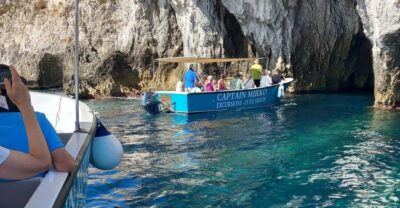 ★ 4.7Syracuse: Boat Tour with Captain Mirko, Snorkeling & CavesFrom $35746 reviews
 ★ 5.0Tour of the island of Ortigia and exploration of sea caves with baths.From $24668 reviews
 ★ 4.7Siracusa: Ortigia Boat Tour with Marine GrottoFrom $45617 reviews
 ★ 4.9Siracusa: Ortigia & Sea Caves Speedboat Tour with Swim StopFrom $34499 reviews
 ★ 5.0Boat tour of Ortigia Island and sea cavesFrom $24407 reviews
 ★ 4.6Catania: Syracuse, Ortigia, and Noto Tour with BrunchFrom $112404 reviews
 ★ 4.7Syracuse: Neapolis Archaeological Park Small Group TourFrom $26350 reviews
Browse the lists this tour appears in