
Reviewed · CATANIA CITY & FISH MARKET TOURS
Catania walking Tour – small group
Catania hits fast. This small-group walking tour helps you get your bearings in about two hours, covering major sights in the center without turning the day into a marathon.
I like the tight focus. You’ll spend time in the places that define Catania’s character, and the multilingual guide approach makes the history feel clear, not like a lecture.
One possible drawback: the pace is efficient, so if you want long, inside-the-walls exploring, you may need follow-up time on your own, especially around stops where entry is not included.
Key highlights worth your time
- Efficient 2-hour route that strings together Catania’s biggest highlights
- Small group size (max 15) for a more personal feel and easier questions
- Cathedral and fish market stops that show the city’s spiritual and daily life side
- Roman and baroque mix in one outing, including theatre and amphitheatre viewpoints
- Via dei Crociferi for a concentrated hit of Catania’s dramatic baroque street-scene
- A smooth meeting point near public transportation, with the tour ending where it starts
Price and what you really get for $24
At $24 per person for roughly two hours, this is the kind of tour that works as a foundation. You are paying mainly for time-saving guidance, a route that makes sense on foot, and a guide who can connect what you see to why it matters.
The tour includes a multilingual guide, and that is a real value booster when you are walking through dense, detail-heavy streets. Even a short visit benefits from someone pointing out what to notice, like where baroque style shifts, or how the city’s layers show up in plain sight.
A fair consideration: several major sights have entrance tickets not included. So the headline price is attractive, but you might spend a little more if you decide to go into the theatres or similar paid viewpoints.
You can also read our reviews of more walking tours in Sicily



Meeting point and timing: how to make the start painless
The meeting point is Via Erasmo Merletta, 3, 95124 Catania CT, Italy. It starts at 10:30 am, and the tour ends back at the same place, so you are not left playing transit roulette afterward.
Because the meeting point is described as near public transportation, I recommend arriving a bit early and planning to be ready to walk right away. Catania’s center is compact, but your timing still matters, especially if you want time later for lunch or an Etna-style day trip.
Also, you’ll use a mobile ticket, which keeps things simple. No paper hunt, no last-second tech stress, and you can focus on getting oriented.
How the walking route helps you read Catania’s baroque center
This tour is designed to “fit the essentials” into a short window. You will move through the center, including a street-and-square feel for the old core, so you get more than a list of landmarks. You start seeing patterns: where grand facades dominate, where everyday life crowds in, and how the city’s design funnels you from one moment to the next.
The second largest city on the island, Catania has a historic center known for baroque architecture. A good tour like this helps you understand why it looks the way it does, without making you wait for a museum visit.
The best part of a short walk is that it gives you options. After two hours, you can choose to go deeper on the places that grabbed you most, instead of trying to do everything at once.
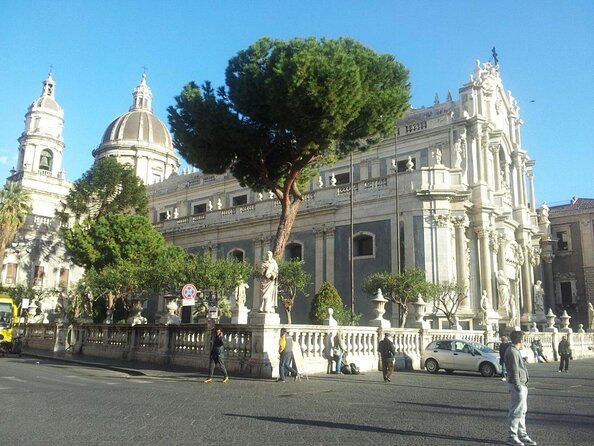
Catania Cathedral and Sant’Agata: the heart stop that sets the tone
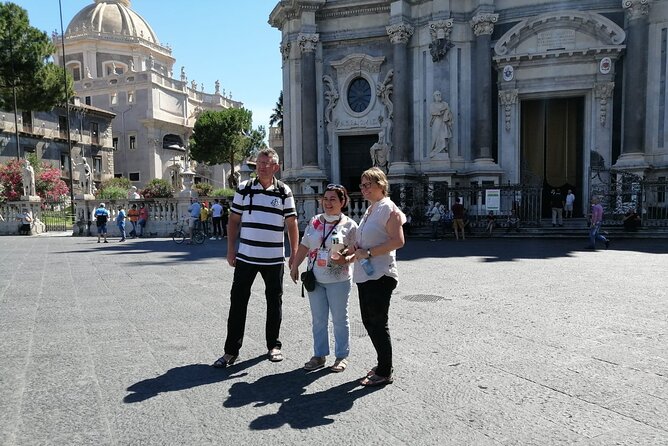
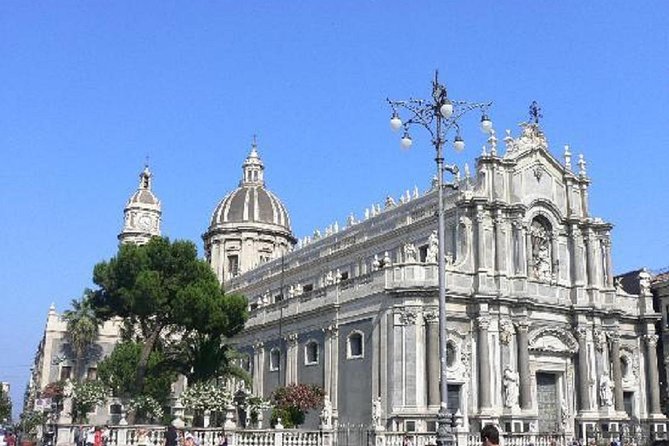
Your cathedral stop is centered on Basilica Catedrale Sant’Agata V.M. Catania. The admission is free for this stop, which makes it a strong value piece of the route. You get a meaningful “anchor” moment that frames the rest of the morning.
Even if you are not a church-superfan, this is the kind of site that helps you decode the city. Sant’Agata is tied to Catania’s identity, and the cathedral’s presence shapes how locals think about the city’s past and present.
The only caution is time. Cathedral time on a walking tour is often brief, so if you want extended quiet, artwork viewing, or slow photos, you will want to plan return time later.
Catania fish market: where the city shows up in real life

The Catania Fish Market stop is short, but it is memorable because it’s not staged. A market is where you see daily rhythm and local priorities fast, and that matters in a place where the streets can otherwise feel like scenery.
This is a free admission stop, so it does not add cost to your morning. It also helps break up the architecture focus so you are not just staring at facades the whole time.
If you like food culture, you will leave with better instincts for where to eat and what to try later. Even when the stop is brief, market sights tend to stick.



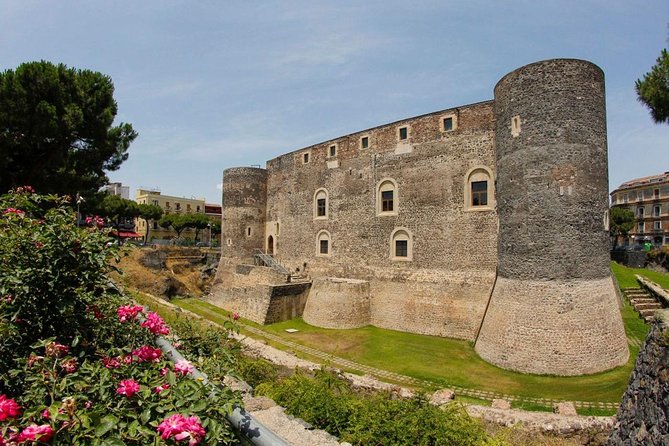
Roman Theatre, Roman Amphitheatre, and Teatro Massimo Bellini
Catania has multiple layers, and this tour gives you a concentrated Roman-and-baroque sweep. The route includes a Greek-Roman theatre stop (admission not included), plus later stops linked to the Roman amphitheater and Teatro Massimo Bellini (both also admission not included).
Here is the practical side: since entrances are not included, you should decide on the spot whether to pay to go in. If you are short on time or prefer to keep the day light, you can still use the stop for views and orientation, then continue.
These Roman stops also help you understand why Catania feels both ancient and theatrical. You can see how later eras adapted earlier shapes, and how baroque style and Roman scale keep coexisting in the same walking range.
One more tip: for paid entries, have your expectations set in advance. A short guided stop means you will likely get highlights rather than long-form museum-style exploration.
Via dei Crociferi: the baroque street that makes everything click
Via dei Crociferi is one of those streets where one block can feel like a whole chapter. This is a free admission stop and a great use of tour time because it delivers visual payoff quickly.
On a walking tour, a baroque street is more than eye candy. It helps you understand the city’s design logic, like how facades, balconies, and street rhythm work together to create drama at human walking speed.
If you want a simple take-away, it’s this: after Via dei Crociferi, you start recognizing baroque details elsewhere in the center. That means your self-guided wandering gets better right away.
Pacing, group size, and the guide voice
The tour caps at 15 travelers, which is why it can feel manageable even in a busy city. A smaller group also makes it easier for the guide to adjust when people pause, ask questions, or need a moment to catch up.
On the guide side, the experience is often praised for clear narration and good storytelling. Some guides, such as Esther and Angela, have been highlighted for bringing architectural points to life and keeping the pace comfortable.
One consideration to keep in mind: commentary can be uneven between stops. If your guide prefers a quieter walking style, you might hear more at the destinations and less while moving. That’s not automatically a problem, but it does mean you should stay alert during transitions and ask questions if something sparks your interest.
If you like tours where you get constant narration every step, you may want to plan your expectations for a stop-based style.
Extra entries and optional museums: how to think about costs
This tour is priced for the guided walk experience. Entrance to museums (optional) is not included, and several key sights on the route also list admission as not included.
So how do you budget this morning? Keep $24 as your base cost, then add what you choose to pay for. If you decide to enter the Roman theatre, the amphitheatre, or similar paid spaces, your final total will go up.
If you want the best value math, treat paid entries as “selective.” Go in only if you are especially interested, or if you think the interior will add something you cannot get from the street views.
What this tour sets you up for afterward
A short, well-guided walk is perfect for building momentum. After two hours, you should feel confident about where you are and how the city is laid out.
Catania also sits near Mt. Etna, and the city’s identity often feels stronger when you connect the dots between the volcanic setting and the architecture. If you are planning an Etna visit later, this tour can give you a sharper sense of what you are looking at back in town.
For a follow-up plan, pick one or two interests and go longer. Cathedral lovers can return for slower viewing. Architecture fans can re-walk Via dei Crociferi at a different hour for different light. Food-focused travelers can extend their morning into a meal that matches what you saw at the fish market.
Who should book, and who might want a different format
This is a great fit if you want major Catania highlights quickly. It is also ideal when you are mixing big activities into a packed schedule, because you are not trapped for the whole day.
Most travelers can participate, and the pacing is designed to stay realistic. If you prefer short guided orientation over long museum time, this delivers.
If you want a deep-dive tour with extended entry time, museum focus, or long Q&A with lots of on-the-go commentary, you might find this best as your first stop in Catania, not your only tour.
Should you book this Catania walking tour?
Yes, I’d book it if you’re visiting Catania for the first time and want to get oriented fast. The combination of the cathedral, fish market, baroque street energy, and Roman layers in a small-group format is exactly what makes a short guided walk worth paying for.
It is also a smart buy when you like flexibility. The tour leaves room to plan other activities afterward, and the “optional entry” parts let you decide how much you want to spend inside.
Skip it only if you know you want long interior visits and constant narration while walking. For many people, though, this is the kind of half-morning that turns a confusing city into something you can navigate and enjoy right away.
FAQ
How long is the Catania walking tour?
It lasts about 2 hours.
How much does it cost?
The price is $24.00 per person.
What language is the tour offered in?
It is offered in English, and it may be operated by a multilingual guide.
How many people are in the group?
The tour has a maximum of 15 travelers.
Where do I meet the guide?
The meeting point is Via Erasmo Merletta, 3, 95124 Catania CT, Italy.
What time does the tour start?
The start time is 10:30 am.
What’s included in the tour price?
A multilingual guide is included. Admission is free for some stops, and some sights have admission not included.
What is not included?
Entrance to museums (optional) is not included, and food and drinks are not included.
Do I get a mobile ticket?
Yes, the tour uses a mobile ticket.
Can I get a refund if I cancel?
You can cancel for a full refund if you cancel up to 24 hours in advance of the experience start time.
More Walking Tours in Sicily


More Tours in Sicily



More Tour Reviews in Sicily
Not for you? Here's more nearby things to do in Sicily we have reviewed









Catania City & Fish Market Tours, compared.
 ★ 4.8Catania: Mount Etna Morning or Sunset Day Trip with TastingFrom $704,028 reviews
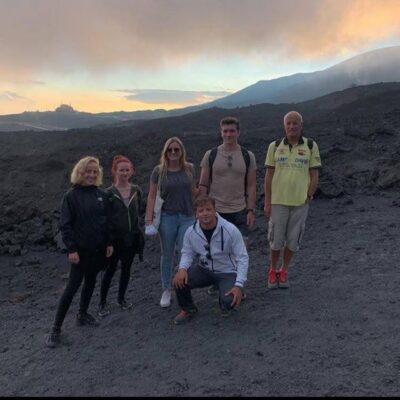 ★ 4.8Catania: Sunset Jeep Tour of Mount Etna and Lava Flow CavesFrom $712,113 reviews
 ★ 4.9Catania: Mount Etna Trekking Trip off the Tourist PathFrom $781,351 reviews
 ★ 4.8Catania: Etna Sunset Tour with Pickup and Drop-offFrom $711,348 reviews
 ★ 5.0Mt. Etna and Taormina village full day tour from CataniaFrom $1181,155 reviews
 ★ 4.7From Catania: Mount Etna Sunset Tour with Tasting and CaveFrom $451,119 reviews
 ★ 4.8Catania: Etna Morning Excursion with Tasting and PickupFrom $67820 reviews
 ★ 4.9Catania: Amazing Etna Morning Tour with Pickup and Drop-OffFrom $81799 reviews
Browse the lists this tour appears in