
Reviewed · SYRACUSE & ORTIGIA TOURS
Classical Ortigia Guided Group Tour
Nine stops, one tight storyline in Ortigia. This 2 hour guided group walk threads Greek Syracuse to Baroque Syracuse, then sends you to the sea and the Jewish quarter, all with a guide who keeps history clear and moving. Starting at the Temple of Apollo, you get a simple route that still feels like you are hearing the whole city speak.
I especially like the pacing and photo time. Stops are short but not rushed, and the schedule builds in breathing room, including a break around Syracuse Cathedral. I also like that you get a real guide voice, with radio guide receivers used for larger groups, which helps when streets get busy.
One consideration: the cathedral interior is optional and costs extra, about 2 euros per person, so plan a small add-on if you want inside. And since the tour requires good weather, it can be rescheduled or refunded if conditions are poor.
Key takeaways before you go
- Temple of Apollo start: you begin with the Greek layer right where it matters
- Small group size: up to 20 people, with radio receivers if needed
- Most entries are free: only the optional Syracuse Cathedral interior has an extra fee
- Caravaggio connection: Santa Lucia alla Badia is framed by the painting that locals care about
- Myth at Fonte Aretusa: papyrus plants and the Aretusa story at the water’s edge
- Sea views in the route: the tour reaches Ortigia’s eastern promenade and Cala Rossa
Ortigia in 2 hours: what this loop actually covers
Ortigia is the compact heart of Syracuse, and this tour is built for people who want orientation fast. In just about 2 hours, you move through the core sights that explain how Syracuse layers cultures: Greek foundations, medieval streets, Baroque churches, and the sea front.
You will be walking through alleys and squares, not riding around. That makes the experience feel more like a local stroll than a bus tour. It also means the order matters. You start with an ancient landmark, then let the route gradually “grow” into the cathedral area, and finally reach the water and the neighborhoods nearby.
With a maximum group size of 20, you should find it easier to hear the guide and keep your bearings. And if your group is on the larger side, the radio guide receivers help a lot in the tight streets.
You can also read our reviews of more guided tours in Sicily

Meeting at the Temple of Apollo: the Greek layer begins
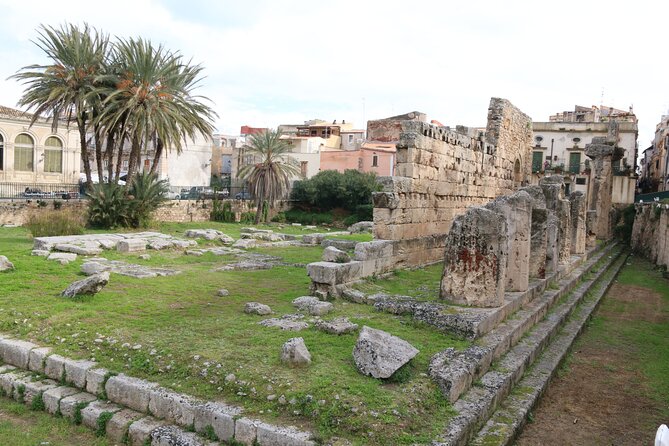
Your tour starts at the Apollonion, the Temple of Apollo. Even if you are not a hardcore archaeology person, this is a strong opener because it tells you what Ortigia used to be. The guide frames the origins of the Greek city and points out what to notice about a temple dedicated to the god of light.
This is also a practical meeting point. It is a clear landmark, and you can arrive a few minutes early to settle in. Most people can participate, and because this first stop is short, it works well even if you are still waking up from a travel day.
Admission here is free, so you can spend your money on food and coffee later without guilt.
Montalto alley stories and Palazzo Montalto
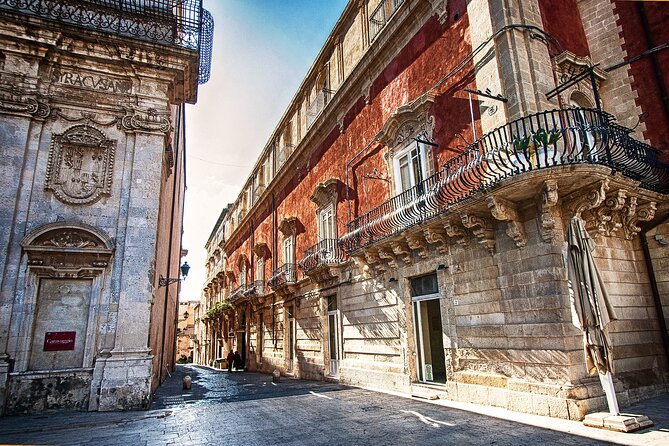
From the temple area, you head into the alley web of Ortigia, including the ancient Spirduta district. This is where the tour shifts from “facts” to “place.” You are not only looking at buildings, you are hearing the kinds of urban legends and local stories that make a place feel lived in.
The highlight is Palazzo Montalto, a medieval palace you reach during the walk. Even if you only see portions from the street, your guide’s context helps you read what you are seeing: why it is here, what kind of era it represents, and how medieval Ortigia evolved in the spaces around the older Greek core.
These segments are usually where the group tour can feel too fast. Here, the time is deliberately short, around 10 minutes. That helps you stay with the information without getting fatigued before the big square stops.
Piazza Archimede and Fontana di Diana: a classic square moment
Next up is Fontana di Diana in Piazza Archimede. This stop is about atmosphere and composition. The fountain is neoclassical, and the square gives you the kind of open framing you do not always get in the narrow streets.
You also get a quick lesson on what to watch for around the square. Your guide points out the buildings that surround Piazza Archimede, which makes your photos better because you know what details are worth capturing. This is a good stop to slow down and look around, rather than just passing through.
Admission here is free, and the tour keeps it to about 10 minutes, so it fits neatly before the bigger “center of gravity” area: the Duomo square.
Piazza Duomo: where Syracuse’s center beats fastest
You then admire Piazza Duomo, described as the sumptuous beating heart of Syracuse. This is a key viewpoint stop, because the square functions like an outdoor museum room. Even if you have seen plenty of European cathedrals, Ortigia’s Duomo area feels different because of the way it sits on multiple layers of time.
The tour does not hang out too long here, which is good. A square stop can drag if the group is slow, but in a route like this it helps you reset your eyes before the cathedral.
Plan for a quick scan of the facades and the general layout. If you do that in the allotted time, the next stop makes a lot more sense.

Syracuse Cathedral: Baroque on top of Greek remains
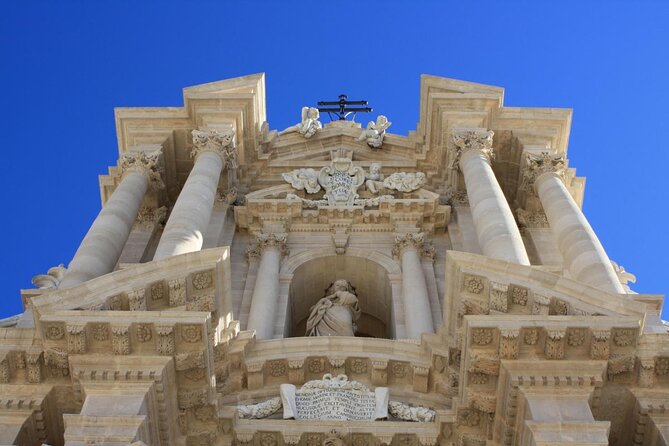
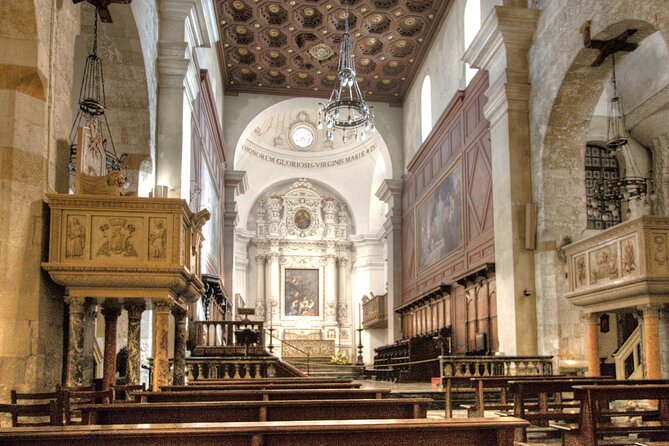
One of the most satisfying parts of this tour is Syracuse Cathedral. Your guide explains the big idea: it is a Baroque-style cathedral built on an ancient Greek temple.
That one concept changes how you look at everything around you. Instead of seeing a single era of architecture, you see a stack. You can connect the idea of rebuilding, reusing, and repurposing across centuries. It is the kind of explanation that makes a cathedral visit feel like understanding a city, not just admiring a facade.
Here is the optional choice. If there are no religious functions, you can visit the interior, but the entrance ticket is not included. The extra cost is 2 euros per person. If you prefer not to go inside, the schedule gives you a short break for coffee.
That coffee break option matters. It turns what could be a rushed “line up and look” stop into something you can actually enjoy. If you do want to go inside, budget the time carefully and be ready to cover the extra fee.
Santa Lucia alla Badia and Caravaggio: why this church is a must
After the cathedral area, you head to Chiesa di Santa Lucia alla Badia. This stop is about significance and story. Your guide shares details about an important religious holiday tied to the church and points to the most important painting of Syracuse, connected to Caravaggio.
This is where a strong guide really earns their spot. If you only look at the outside, you might miss why locals care. With the explanation, you understand what the church represents and why it is not just another stop on a walking circuit.
The stop length is about 15 minutes, with free admission. That is long enough for the guide to set context and still short enough to keep energy up for the coastal part of the tour.
Fonte Aretusa: papyrus plants and a romantic myth
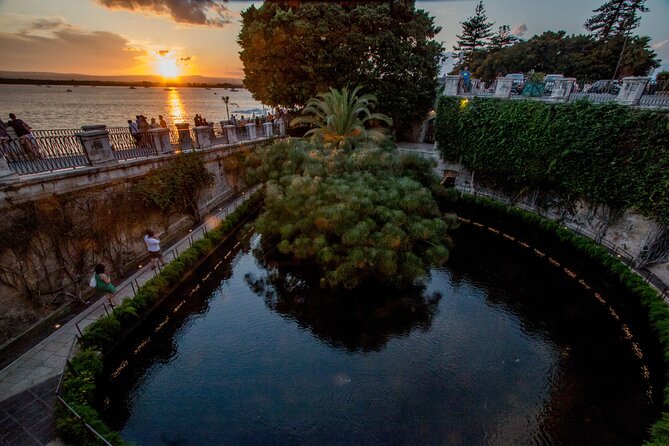
Then the tour shifts to water. You move from Piazza Duomo toward the sea to Fonte Aretusa, a legendary spring tied to a romantic myth. The guide shows you the papyrus plants, which is a fun contrast to the stone streets you just walked.
Fonte Aretusa is one of those places where the explanation helps a lot. A myth can feel like fluff if nobody connects it to place. But when you understand what you are seeing, the scene becomes part practical, part poetic.
This stop is about 15 minutes and the admission is free. It is also a natural time to take a breath. You get open views and the change in environment makes the tour feel like it is moving forward, not just repeating the center.
Cala Rossa and the Levante promenade: the sea break you want
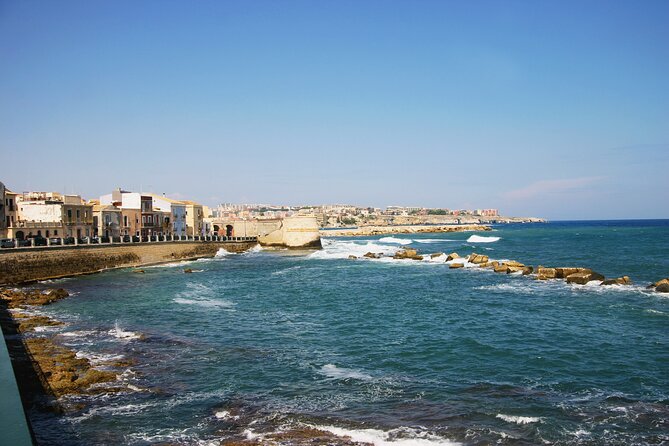
From Fonte Aretusa, you cross over to the island’s eastern promenade, the Lungomare di Levante Ortigia. You also reach Cala Rossa, a small beach area.
This is not just a pretty walk. It is a chance to feel the geography. Ortigia is an island, and the sea helps explain the city’s orientation and energy. Standing by the water, the day’s history stops feeling abstract.
The stop here is about 10 minutes, with free admission. It is short by design, but it gives you enough time to look, take photos, and get that sea air before the final neighborhood finish.
Giudecca district ending: finishing in Syracuse’s older neighborhood streets
The tour ends in a food and neighborhood setting: Fish bar La Via Della Giudecca, reached while crossing the Giudecca district, the ancient Jewish quarter of Syracuse.
You are wrapping with a change of pace. The earlier stops explain big monuments and sacred buildings. Ending in the Giudecca area puts the story into a human scale of street life. Even though the tour is short here, around 20 minutes, it gives you time to pause and re-enter the city as a visitor rather than just a spectator.
The admission for this segment is free, and it works well as a “landing zone.” After the tour, you are right where you can wander further, eat, or continue exploring nearby streets.
Radio receivers, group size, and the guide effect
This is one of those tours where the guide quality really matters, because the sights are dense and the walking is continuous. With a maximum of 20 people, you should get a more personal feel than you would on large group walks. And if the group is big enough to need it, the included radio guide receivers keep the narration clear.
From the tour feedback, the guide focus is on clarity and pacing. Names like Eva come up often for being engaging and giving an in-depth historical perspective across the stops. The route is also paced with photos in mind, so you are not constantly stuck behind someone else.
If you care about getting explanations you can actually use, this is where this tour shines.
Price and value: why $30.12 works for what you see
At $30.12 per person for an approximately 2 hour guided circuit, the value comes from the mix of sights and what is included. Most stops have free admission tickets, so your ticket price covers the guiding and the time, not a pile of entry fees.
The only notable extra is the optional 2 euros for the Syracuse Cathedral interior. If you skip the interior and use the break for coffee, you can keep spending under control.
Also, the tour uses a mobile ticket, which is convenient if you do not want to manage paper while walking. And English is offered, which is important in this part of Sicily if you want smooth storytelling without relying on your own translation skills.
This is especially good value if you are on a tight schedule. Ortigia can be overwhelming at first. A guide helps you see the connections instead of collecting random photos.
Who should book this tour, and who might pass
I think this tour is ideal if you want a smart first pass through Ortigia. It is also great for couples and solo travelers who like group energy but still want time at each stop.
You might consider a different option if you strongly prefer long museum-style visits. Some stops are intentionally short, and the cathedral interior is optional rather than guaranteed. If you want deep time in one place, you would likely combine this with another standalone visit.
Because the tour requires good weather, plan flexibility. If your trip dates are fixed and weather is a concern, you may want to keep that in mind for your overall day plan.
Should you book this Classical Ortigia tour?
If your goal is to understand Ortigia in a compact, walkable format, I would book it. The route hits the big anchor points: Greek origins at the Temple of Apollo, the medieval Palazzo Montalto, the square moment at Fontana di Diana, the layered meaning of Syracuse Cathedral, and the water stop at Fonte Aretusa with papyrus plants.
It also helps that the tour keeps things practical. Most admissions are free. The group stays small. The guide is described as doing a clear job with historical context, and the pacing gives you a chance to look and photograph without feeling yanked along.
If you are happy adding 2 euros per person for the optional cathedral interior, you get a near complete highlight set. If not, you still have enough time built in for a break and a proper walk to the sea and the Giudecca district.
FAQ
How long is the Classical Ortigia Guided Group Tour?
It lasts about 2 hours.
What language is the tour offered in?
The tour is offered in English.
What is the price per person?
The price is $30.12 per person.
Where does the tour meet and where does it end?
It starts at the Temple of Apollo (Apollonion), 96100 Syracuse, and ends at Piazza Archimede, 96100 Siracusa SR, Italy.
Is the cathedral entrance included?
The Syracuse Cathedral interior visit is optional and the entrance ticket is not included. It costs 2 euros per person. If you do not go inside, there is a short break for coffee.
Are any admission tickets included for the other stops?
For the listed stops, the admission tickets are free. The only paid admission noted is the optional cathedral interior.
Does the tour include radio receivers?
Radio guide receivers are included if you are in a larger group.
What happens if the tour is canceled due to weather?
If it is canceled due to poor weather, you will be offered a different date or a full refund.
Can I cancel for a full refund?
Yes. You can cancel up to 24 hours in advance for a full refund. If you cancel less than 24 hours before the start time, the amount you paid is not refunded.
More Guided Tours in Sicily

More Tours in Sicily


More Tour Reviews in Sicily
Not for you? Here's more nearby things to do in Sicily we have reviewed






Syracuse & Ortigia Tours, compared.
 ★ 4.7Syracuse: Boat Trip of Ortigia Island and Sea CavesFrom $23937 reviews
 ★ 4.7Syracuse: Boat Tour with Captain Mirko, Snorkeling & CavesFrom $35746 reviews
 ★ 5.0Tour of the island of Ortigia and exploration of sea caves with baths.From $24668 reviews
 ★ 4.7Siracusa: Ortigia Boat Tour with Marine GrottoFrom $45617 reviews
 ★ 4.9Siracusa: Ortigia & Sea Caves Speedboat Tour with Swim StopFrom $34499 reviews
 ★ 5.0Boat tour of Ortigia Island and sea cavesFrom $24407 reviews
 ★ 4.6Catania: Syracuse, Ortigia, and Noto Tour with BrunchFrom $112404 reviews
 ★ 4.7Syracuse: Neapolis Archaeological Park Small Group TourFrom $26350 reviews
Browse the lists this tour appears in